The Self-Knowledge Experience
A guided experience to help you slow down, notice, and understand yourself more clearly.
This is not a test.
There are no right or wrong answers.
You won’t be scored, diagnosed, or told what your experience means.
You’ll simply be invited to notice, reflect, and listen to yourself.
Your words are for you.
This is a private space for reflection.
This experience does not use AI to read, analyze, interpret, diagnose, or respond to what you write.
Nothing you type is intentionally sent to Self-Knowledge or saved by this experience.
The questions and exercises are already here. They aren’t being generated in response to your story.
Think of it like writing a letter you never intend to send.
You give yourself room to put something into words, read it, learn from it, and then place the letter in the fire.
The words can disappear while what you discovered through writing them stays with you.
Your reflections remain in the current page only while you move through the experience.
When you refresh, close, or leave the page, this experience is designed to clear them.
No account. No profile. No interpretation.
The experience doesn’t need to understand your story. Its purpose is to help you understand it.
Before we begin…
Give yourself 30 seconds to arrive.
You don’t need to think about anything, figure anything out, or accomplish anything.
Let your breathing happen naturally.
Simply notice that you’re here.
Whenever you’re ready…
We’ll begin by showing you how one person moved through this process.
Before you begin, meet Alex.
His experience is only an example. Yours may be completely different.
Alex had an opportunity in front of him, but he couldn’t seem to decide what to do.
He kept thinking about it and telling himself:
“I just don’t want to do this.”
Instead of trying to force a decision, Alex slowed down and looked at the same experience through his Body, Emotion, Mind, and Spirit.
NOTICE — Body
Alex closed his eyes for 30 seconds and simply noticed his body.
What surprised him was tension in his chest. It had been there, but it hadn’t had his attention before.
Nothing interpreted the tension for him. It was simply new information to notice.
FOLLOW — Emotion
Alex initially described himself as frustrated.
But when he returned his attention to the tension in his chest, he noticed something else there: fear.
His frustration wasn’t wrong. It was simply the emotion he noticed first.
UNDERSTAND — Mind
Alex listened to the thoughts connected to the fear.
The first thought was:
“I don’t want to do this.”
When he stayed curious, another thought appeared:
“What if I fail?”
The second thought didn’t make the first one wrong. It helped Alex understand more about what he was experiencing.
CHOOSE — Spirit
Alex didn’t need the tension, fear, or thoughts to disappear.
He allowed all of them to be there and asked himself what felt true beneath everything he had noticed.
What became clear was:
“I’m afraid I might fail, but I still want to try.”
The fear hadn’t disappeared. Alex simply understood more of his experience before choosing what he wanted to do.
His first answer wasn’t wrong.
It just wasn’t the whole experience.
Your experience may look nothing like Alex’s.
We’re not going to look for his answers in you. We’re going to help you notice yours.
What’s happening?
Start wherever feels natural.
Writing can slow an experience down enough for you to notice things that may be difficult to see while they’re moving through your mind.
Don’t try to explain yourself perfectly. Don’t worry about grammar or making it sound good.
Write for yourself.
Not sure where to begin?
“Lately I’ve noticed…”
“Something that keeps coming up for me is…”
“I don’t understand why I…”
One sentence or several paragraphs. There is no right amount.
Read what you just wrote.
Read it slowly. Don’t try to fix or explain anything yet.
What stands out?
Notice any words, phrases, feelings, people, situations, or themes that catch your attention.
You might also notice a word, phrase, or way of describing something that you don’t normally use when thinking about this situation.
Something may surprise you. Nothing may surprise you.
Don’t decide what any of it means yet. Just notice it.
Optional. The important part is noticing, not writing it down.
Next, we’re going to slow the experience down and look at it through the Four Energy Fields.
Body → Emotion → Mind → Spirit
Begin with your body.
Alex thought his experience was mostly about making a decision.
After sitting quietly for 30 seconds, he noticed tension in his chest that hadn’t had his attention before.
He didn’t decide what the tension meant. He simply noticed it.
Now forget Alex’s answer and notice yours.
Close your eyes if that feels comfortable.
Let your breathing happen naturally.
Don’t search for anything. Simply notice your body.
What place in your body has your attention most?
It doesn’t need to hurt, feel unusual, or seem important.
It might be your shoulder, abdomen, lower back, shin, toe, even the knuckle on your thumb.
Whatever got your attention is enough.
Does any of that connect with your experience, or not at all?
There is no universal meaning attached to a place in your body. These are possibilities to explore, not interpretations of what your body means.
Optional. The important part is noticing, not writing it down.
We slowed this down so you could experience what noticing feels like.
With practice, this can become natural and may take only an instant.
Now notice what you feel.
Alex initially described himself as frustrated.
When he returned his attention to the tension in his chest, he noticed fear there.
His frustration wasn’t wrong. He simply noticed another part of the same experience.
Start with the whole experience.
What emotion do you notice overall right now?
Don’t search for the perfect word. Choose whatever feels closest.
This is a way to explore the emotion, not an interpretation of what your emotion means.
Now return to your body.
Bring your attention back to the place that caught your attention a few moments ago.
Simply return your attention there.
Let your breathing happen naturally.
What do you notice there?
What emotion do you notice in that place in your body?
It may be the same emotion you noticed overall.
It may be different. You may not notice an emotion there at all.
Stay curious. You don’t need to make the emotion mean anything yet.
Now compare the two.
The emotion you noticed overall and the emotion you noticed in your body don’t have to match.
You aren’t trying to find a deeper or more correct emotion.
The first emotion wasn’t wrong.
You’re simply following the experience and noticing whether anything else is there.
Optional. The important part is noticing, not writing it down.
Now listen to your mind.
Alex’s first thought was:
“I don’t want to do this.”
When he stayed curious, another thought appeared:
“What if I fail?”
The second thought wasn’t more correct. It simply gave Alex more information about the first.
Return to your experience.
Bring the place in your body and the emotion you noticed gently to mind.
What thought comes with them?
Don’t try to create a better thought. Simply notice what your mind says first.
It may sound something like:
“I have to…”
“I can’t…”
“What if…”
“They’ll…”
“I should…”
“This always…”
Or it may sound nothing like these.
Stay curious for another moment.
Sometimes the first thought tells us exactly what we need to notice.
Sometimes another thought appears when we stay with the experience a little longer.
Is there another thought underneath, behind, or alongside the first one?
Notice what you’re treating as true.
A thought can feel unquestionably true simply because it appears quickly, strongly, or repeatedly.
You don’t need to decide whether the thought is right or wrong.
Just notice whether there’s a statement you’re treating as a fact.
Now try something simple.
Take that statement and turn it into a question.
“I can’t do this.”
becomes
“Can I do this?”
or
“They’re going to judge me.”
becomes
“Are they going to judge me?”
Don’t rush to answer the question.
Just notice what happens when a statement becomes a question.
Does anything change in your Body, Emotion, or Mind?
Understanding doesn’t require finding the “correct” thought.
Sometimes understanding begins simply by seeing that a thought is a thought, rather than automatically treating it as the whole truth.
Now step back and notice the whole experience.
Alex still noticed tension in his chest. The fear was still there. His mind could still imagine failure.
He didn’t need any of those things to disappear before he could notice something else.
“I’m afraid I might fail, but I still want to try.”
Alex hadn’t eliminated his fear. He could simply see more of himself than the fear alone.
Let everything you’ve noticed be here.
The place in your body.
The emotion or emotions you noticed.
The thoughts your mind brought forward.
You don’t need to change, quiet, or resolve any of them.
Now step back a little.
You are aware of the sensation.
You are aware of the emotion.
You are aware of the thought.
What else do you notice?
There isn’t a particular answer to find.
You might notice something about meaning, connection, direction, stillness, what matters to you, or what feels true.
Or nothing may feel especially clear yet.
Knowing everything you’ve noticed…
What would you choose?
You don’t need your Body, Emotion, or Mind to become perfectly quiet first.
Choice can begin with seeing the whole experience more clearly.
These weren’t four separate experiences.
You looked at the same experience from four different places.
Now see the whole experience.
We slowed everything down and explored one field at a time so you could learn how to notice each one.
In everyday life, your Body, Emotion, Mind, and Spirit aren’t taking turns.
They are different parts of the same experience, happening together.
BALANCE
Spirit is the larger field.
Body, Emotion, and Mind exist within Spirit and continually influence one another.
The center represents the place where Body, Emotion, and Mind come into greater alignment within Spirit.
Balance doesn’t mean every field has to feel good or agree.
It means you can experience more of what is happening without one part completely obscuring the others.
Think about what you just did.
You noticed something in your Body.
You followed it into Emotion.
You listened to your Mind.
Then you stepped back into Spirit and considered the whole experience.
Nothing necessarily had to disappear.
You simply gave yourself an opportunity to see more of what was already there.
Alignment Opens the Aperture
Now take the idea one step further.
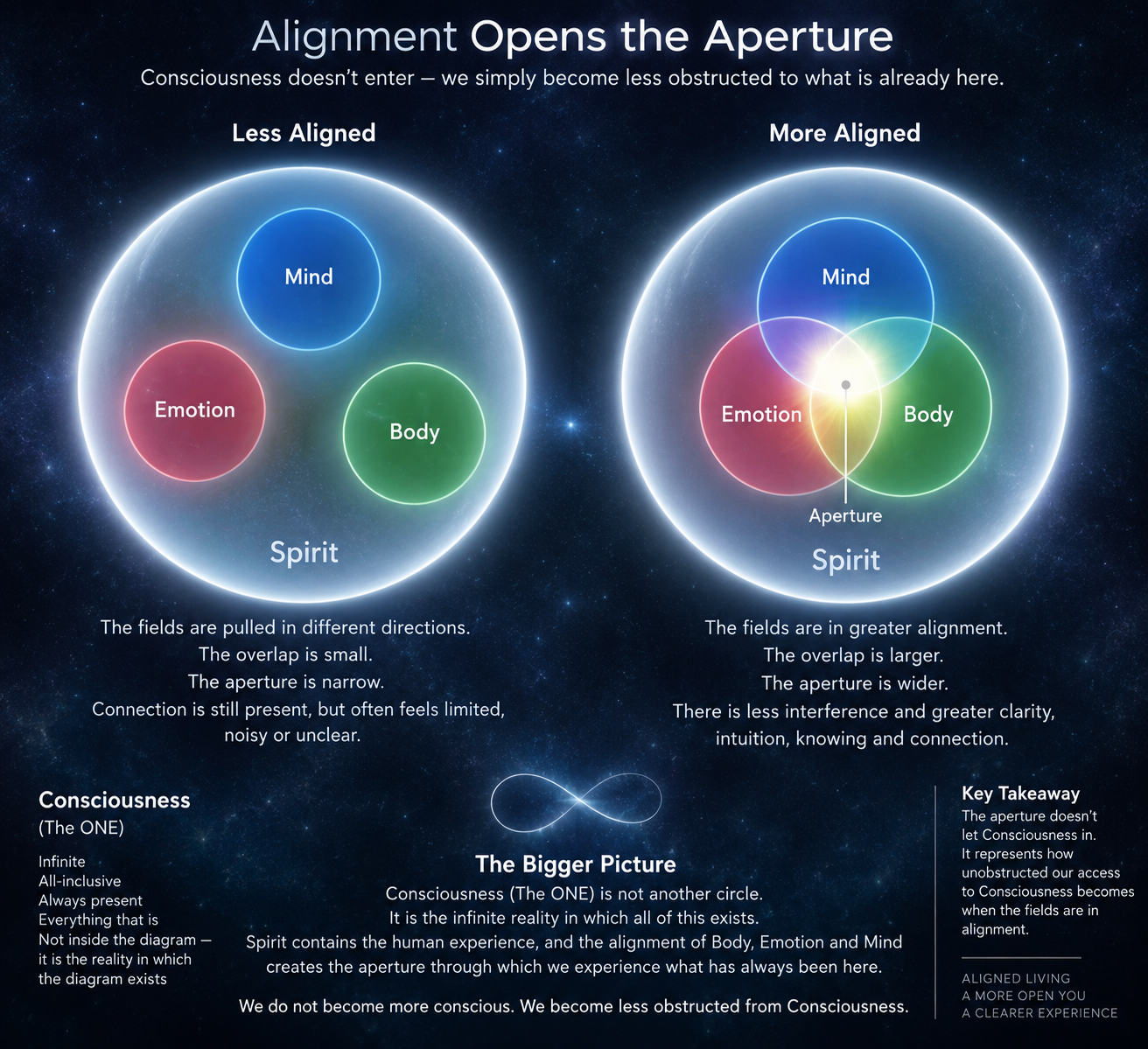
Notice what happens in the graphic as Body, Emotion, and Mind move into greater alignment within Spirit.
The place where the fields overlap becomes larger.
That doesn’t mean becoming a different person.
It doesn’t mean eliminating uncomfortable sensations, emotions, or thoughts.
It represents less interference between the different parts of your experience.
Consciousness is already present.
In this model, Consciousness isn’t something you have to create, earn, or become.
As the fields move into greater alignment, the aperture opens.
You don’t become more conscious. You become less obstructed from Consciousness.
That’s what you’ve been practicing.
You didn’t try to silence your Body.
You didn’t try to eliminate your Emotion.
You didn’t force your Mind to think differently.
You noticed each field, followed what had your attention, and created more room to understand the whole experience.
What do you understand now?
Return for a moment to where you began.
Read your original words again.
You don’t need to rewrite the story or explain every step you just experienced.
Simply notice whether you see anything differently now.
Maybe you noticed something in your body that wasn’t obvious before.
Maybe an emotion became clearer.
Maybe you saw a thought or assumption from a different perspective.
Maybe something about what matters, what feels true, or what you want became easier to see.
Or maybe you’re simply more aware of the experience than you were when you started.
You don’t need a breakthrough.
Understanding can be as simple as seeing one part of your experience a little more clearly.
In your own words…
Capture the experience. You don’t need to document every step.
This is what you understand today.
It doesn’t have to be perfect, complete, or permanent.
You may return to the same experience later and notice something different.
That doesn’t mean what you noticed today was wrong.
Look at where you began and what you understand now.
These are your words and your experience.
Nothing here has been interpreted or analyzed for you.
We’ve simply brought together what you chose to record during this experience.
Where I began
What stood out to me
What I noticed along the way
You didn’t need to write down every step for the experience to matter.
NOTICE — Body
You spent time noticing your body.
FOLLOW — Emotion
You followed what you noticed into emotion.
UNDERSTAND — Mind
You noticed the thoughts and assumptions connected to your experience and practiced turning certainty back into curiosity.
CHOOSE — Spirit
You stepped back and considered the whole experience.
What I understand now
You just practiced Self-Knowledge.
Notice what happened.
You began with an Experience.
↓
By slowing down and noticing, experience became Information.
↓
By exploring what you sensed, felt, and thought, information became Knowledge.
↓
By seeing how the pieces related, knowledge moved toward Understanding.
↓
When you use what you understand to choose how you want to respond, understanding can become Wisdom.
This process belongs to you.
What you practiced here isn’t something the website did for you.
It’s something you did for yourself.
As the process becomes more familiar, you may begin moving through it naturally in everyday life, sometimes in only a few moments.
When something has your attention…
NOTICE — Body
What do I notice?
FOLLOW — Emotion
What do I feel?
UNDERSTAND — Mind
What am I thinking, assuming,
or believing?
CHOOSE — Spirit
Knowing all of that,
what feels true and what do I choose?
And you’re always welcome back.
Sometimes you may move through this process naturally on your own.
Other times, it can help to slow down, create some space, and be guided through the experience again.
Whenever you’d like that space, you can come back and begin again.
Think of it as a private, one-on-one Self-Knowledge session with yourself.
Each time you return, you may notice something different.
That’s part of the process.
What happens to these words is up to you.
If you’d like to keep this reflection, you can print it, use your browser’s Save as PDF option, or take a screenshot.
Or simply close the page.
Like placing a letter in the fire, the words can disappear while what you learned from writing them stays with you.
On a phone, taking a screenshot may be the simplest way to keep a copy.
Stay with what you discovered.
You don’t need to do anything else.
Sometimes the most useful thing after an experience like this is simply to let it settle.
If you’d like to spend a little more time with yourself, you can choose one of the practices below.
Nothing here is being recommended based on what you wrote.
Your writing has not been interpreted or analyzed.
Choose only what feels useful to you.
Everything changes the moment you begin to understand yourself.